
Do You Need to Take Vitamin C With Collagen?
You take collagen every day. Do you need vitamin C with it, or is your diet enough?
Your body needs vitamin C to make collagen. But that does not automatically mean you need a separate vitamin C supplement. If your diet already supplies enough, adding more is not proven to improve your results.
The useful question is whether you are getting enough vitamin C consistently. Here is why it matters, what the research shows and where Axiomé™ Vitamin C Bioactive fits.
If you read Why Your Collagen Isn’t Working, you know the distinction between native and hydrolyzed collagen. This is the next part of the conversation: the role vitamin C plays when your body makes its own collagen.

Why does collagen need vitamin C?
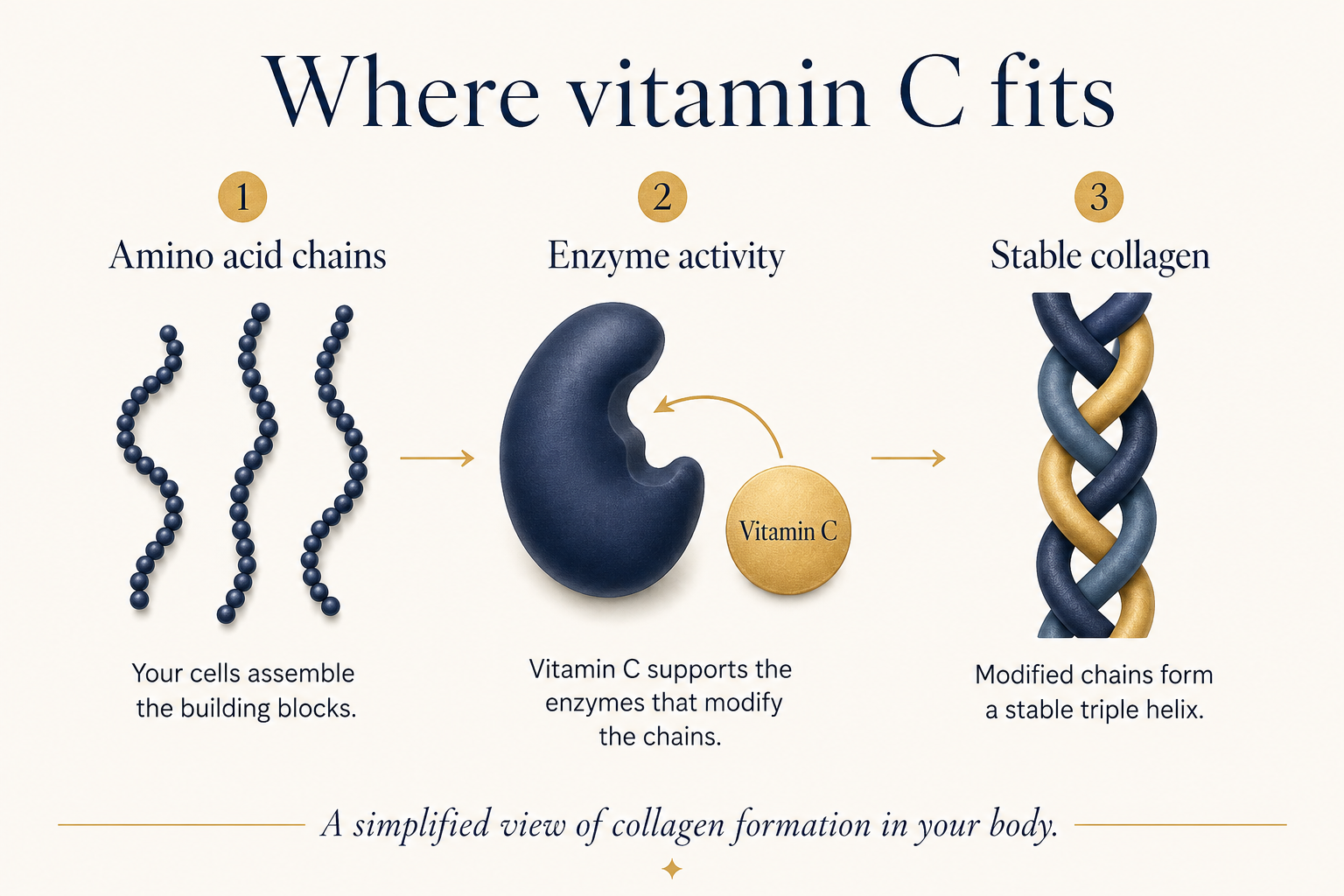
Collagen begins as chains of amino acids. Before those chains form a stable triple helix, enzymes modify specific proline and lysine residues. This step is called hydroxylation.
Vitamin C helps keep these enzymes working. It restores iron in the enzyme to its active state when it becomes oxidized. Without sufficient vitamin C, normal collagen formation is disrupted. [1]
You do not need to remember the enzyme names. The useful distinction is between supplying building blocks and having what your body needs to assemble them.
What scurvy teaches us
Scurvy is the clearest example of what happens when vitamin C is missing. Severe deficiency affects connective tissue, with symptoms including bleeding gums and poor wound healing. [2]
The lesson is straightforward. Protein intake does not replace vitamin C. Your body needs both the building blocks and the nutrients involved in collagen formation.
That does not mean everyone taking collagen needs an additional vitamin C supplement. Food contributes to your vitamin C intake too.
Does extra vitamin C improve collagen results?
Vitamin C’s role in collagen formation is established. Whether adding more vitamin C to an already adequate intake improves the results of a collagen supplement is a different question.
A 16-week randomized trial published in Nutrients in 2024 studied formulations containing hydrolyzed collagen and vitamin C. Researchers reported improvements in several skin measurements compared with placebo. But the study did not include a collagen-only group, so it cannot tell us how much vitamin C contributed to those results. [3]
An earlier trial involving 32 participants compared collagen tripeptide, collagen tripeptide with vitamin C, vitamin C alone and no supplementation over 12 weeks. Collagen alone improved hydration and elasticity. Adding vitamin C did not produce a measurable additional benefit in that trial. [4]
Adequate vitamin C matters. Taking more than you need is not proven to deliver better collagen results.
How much vitamin C do you need?
The US National Institutes of Health gives the following recommended daily amounts for adults aged 19 and older: [2]
- Women: 75 mg a day.
- Men: 90 mg a day.
- People who smoke: an additional 35 mg a day.
Pregnancy and breastfeeding have different requirements. The adult upper limit is 2,000 mg a day from all sources. This is a limit, not a target.
These figures describe total intake. They are not instructions to add that amount as a supplement on top of your diet.
What’s in Axiomé™ Vitamin C Bioactive?

Each capsule combines Bitter Orange extract and Germinating Buckwheat extract, delivering vitamin C from botanical sources rather than a synthetic ascorbic acid isolate. Axiomé™ Vitamin C Bioactive, NPN 80117421, comes in bottles of 120 capsules. Take one capsule a day with food.
Take Collagen Reserve for the structure. Take Vitamin C Bioactive for the enzyme that builds it. Together they cover both sides of one biochemical process, not two unrelated products sold as a bundle.

Explore Axiomé™ Vitamin C Bioactive
Common questions
Do I need to take vitamin C at the exact same time as my collagen?
No. Collagen synthesis runs continuously in your body. What matters is adequate vitamin C intake over time, rather than taking the two capsules in the same five minutes. Follow each product’s directions for use.
Can I get enough vitamin C from food?
Yes. Citrus fruit, peppers and strawberries are food sources of vitamin C. A diet that supplies enough consistently can meet your needs.
Does more vitamin C mean more collagen?
There is no strong evidence that taking vitamin C beyond an adequate intake produces additional collagen benefits. Meeting your needs and exceeding them are different things.
Is the vitamin C in Axiomé™ Vitamin C Bioactive natural or synthetic?
It comes from Bitter Orange extract and Germinating Buckwheat extract, both botanical sources. There is no synthetic ascorbic acid isolate in the formula.
Will vitamin C fix a collagen routine that isn’t working?
Correcting inadequate vitamin C intake addresses one possible problem. It does not answer every question about your supplement, its formulation or how consistently you take it. Our guide to native versus hydrolyzed collagen explains the structural distinction.
Build a considered collagen routine
Know which collagen you are taking. Understand what vitamin C contributes. Follow the directions for each product.
Explore Axiomé™ Vitamin C Bioactive
Sources
[1] Vasta JD, Raines RT. Human Collagen Prolyl 4-Hydroxylase Is Activated by Ligands for Its Iron Center. Biochemistry. 2016. Read the paper.
[2] NIH Office of Dietary Supplements. Vitamin C: Health Professional Fact Sheet. Read the fact sheet.
[3] Žmitek K et al. The Effects of Dietary Supplementation with Collagen and Vitamin C and Their Combination with Hyaluronic Acid on Skin Density, Texture and Other Parameters. Nutrients. 2024, 16(12), 1908. Read the study.
[4] Choi SY et al. Effects of collagen tripeptide supplement on skin properties: a prospective, randomized, controlled study. Journal of Cosmetic and Laser Therapy. 2014, 16(3), 132–137. Published online in 2013. Read the study.